
According to the research team of Rentelligence, understanding the distinction between AI agents and large language models has become essential for organizations looking to implement intelligent automation solutions. Both technologies have revolutionized how businesses approach problem-solving, yet they serve fundamentally different purposes in the modern AI landscape.
AI Agents vs LLMs: Understanding the Critical Differences Between ChatGPT and Autonomous AI Systems
Overview: The Evolution of Artificial Intelligence Technology
According to the research team of Rentelligence, the global AI agents market has experienced remarkable expansion, with valuations reaching USD 7.63 billion in 2025 and projected to grow at a compound annual growth rate of 45.8% through 2030. This explosive growth reflects the increasing demand for automation solutions that go beyond simple language processing, driven by organizations seeking to automate complex workflows and enhance operational efficiency.
The distinction between AI agents and large language models like ChatGPT represents a fundamental shift in how artificial intelligence operates in business environments. While large language models excel at understanding and generating human-like text, AI agents introduce autonomous decision-making capabilities, real-time task execution, and continuous learning from interactions. The Rentelligence team emphasizes that choosing between these technologies requires understanding both their unique strengths and limitations.
As businesses evolve their digital strategies, the ability to differentiate between reactive systems that respond to prompts and proactive systems that anticipate needs becomes crucial. This comprehensive guide examines the core differences, advantages, and practical applications of each technology to help organizations make informed decisions about their automation investments.
What Are Large Language Models and How Do They Function?
Understanding LLM Architecture and Core Capabilities
Large language models represent a breakthrough in natural language processing, utilizing transformer architectures and deep learning techniques to process and generate human-like text. According to Rentelligence research experts, LLMs like GPT-4, Claude, and Gemini are trained on massive datasets containing billions of text samples, enabling them to predict word sequences and generate contextually appropriate responses.
The operational model of LLMs follows a straightforward workflow that begins with text input processing. When users provide a prompt or query, the LLM tokenizes the input—breaking it into smaller units for analysis—and then predicts the next word in a sequence based on probabilistic patterns learned during training.
Key Characteristics of Large Language Models Include:
- Natural Language Processing Excellence – LLMs demonstrate superior performance in understanding context, grammar, and semantic relationships within text
- Contextual Understanding – These models can maintain conversation context across multiple exchanges, generating coherent and relevant responses
- Scalability Across Complexity Levels – LLMs handle tasks ranging from simple queries to detailed report generation
- Pre-training and Fine-tuning Capabilities – Models are pre-trained on vast datasets, then specialized for specific domains like healthcare, legal, or financial sectors
- Multimodal Processing – Advanced LLMs now process images, audio, and video alongside text
The Training Process and Learning Mechanisms
The Rentelligence team identifies training as the foundation of LLM capabilities, utilizing both supervised and unsupervised learning approaches. Supervised learning involves training on labeled datasets where correct answers are provided, while unsupervised learning discovers patterns in unlabeled data. This dual approach enables LLMs to develop nuanced understanding of human language.
LLM Interaction Models and Limitations
Large language models operate in a reactive manner, requiring explicit user prompts to generate responses. Once a user provides input, the model processes the query and delivers output—but without further prompting, the LLM cannot take independent actions or continue working toward objectives.
ChatGPT Limitations and Real-World Constraints
According to the Rentelligence research community, ChatGPT and similar LLMs face several significant limitations that impact their practical deployment for enterprise applications. The model lacks real-time internet access for free users, struggles with long-form structured content, and sometimes generates responses with repetitive information or grammatical inconsistencies.
Context comprehension remains challenging for LLMs, as they occasionally misinterpret nuanced queries or fail to grasp complex subject matter deeply. Additionally, these models cannot access proprietary company data, execute code independently, or interact with external systems without integration with other tools.
What Are AI Agents and How Do They Transform Business Operations?
Core Principles Defining AI Agent Functionality
According to the Rentelligence research team, AI agents represent a paradigm shift from passive language systems to autonomous, goal-oriented entities capable of independent decision-making and action execution. An AI agent is a software program that perceives its environment, analyzes data, and autonomously executes actions to achieve predetermined objectives without continuous human oversight.
The architecture of an AI agent explained by the Rentelligence team comprises several interconnected components working in harmony. These include perception modules that gather data from environments, cognitive modules that process information and make decisions, action modules that execute responses, and learning mechanisms enabling continuous improvement.
Core Characteristics of AI Agents Include:
- Autonomous Operation – AI agents make decisions and execute tasks independently once goals are defined
- Goal-Oriented Behavior – Agents pursue specific objectives and evaluate whether actions align with target outcomes
- Environmental Perception – Through sensors, APIs, or digital inputs, agents gather real-time information about their surroundings
- Real-Time Decision-Making – Agents analyze data instantaneously and take immediate actions in response
- Continuous Learning – Using reinforcement learning and supervised learning methods, agents improve performance over time
- Tool Integration – Agents connect to external systems, APIs, and databases to extend their capabilities
- Proactive Anticipation – Unlike reactive systems, agents predict future events and prepare accordingly
The Agentic AI Workflow and Multi-Step Task Execution
The Rentelligence team emphasizes that what is agentic workflow represents a multi-stage process where agents break complex objectives into manageable subtasks. The agent receives a high-level goal, develops an action plan, executes tasks sequentially, monitors outcomes, and adjusts strategies based on feedback.
This multi-step approach distinguishes AI agents from LLMs, as the agent doesn’t simply respond to a prompt—it continuously works toward goal completion. For instance, when processing a customer service request, an agent might retrieve customer history, analyze the issue, access knowledge bases, execute a solution, update systems, and escalate if necessary—all without human intervention.
Single Agent Systems vs Multi-Agent Systems Architecture
The Rentelligence research community identifies two primary deployment models for agentic AI systems. Single agent systems involve one central AI agent managing all tasks independently, while multi-agent systems deploy multiple specialized agents working collaboratively under orchestration.
Single agent systems offer simplicity and centralized control, suitable for focused automation tasks. Multi-agent systems provide superior scalability and efficiency for complex workflows, with each agent specializing in distinct functions—much like microservices in software development.
Cloud vs Local AI Agents Comparison
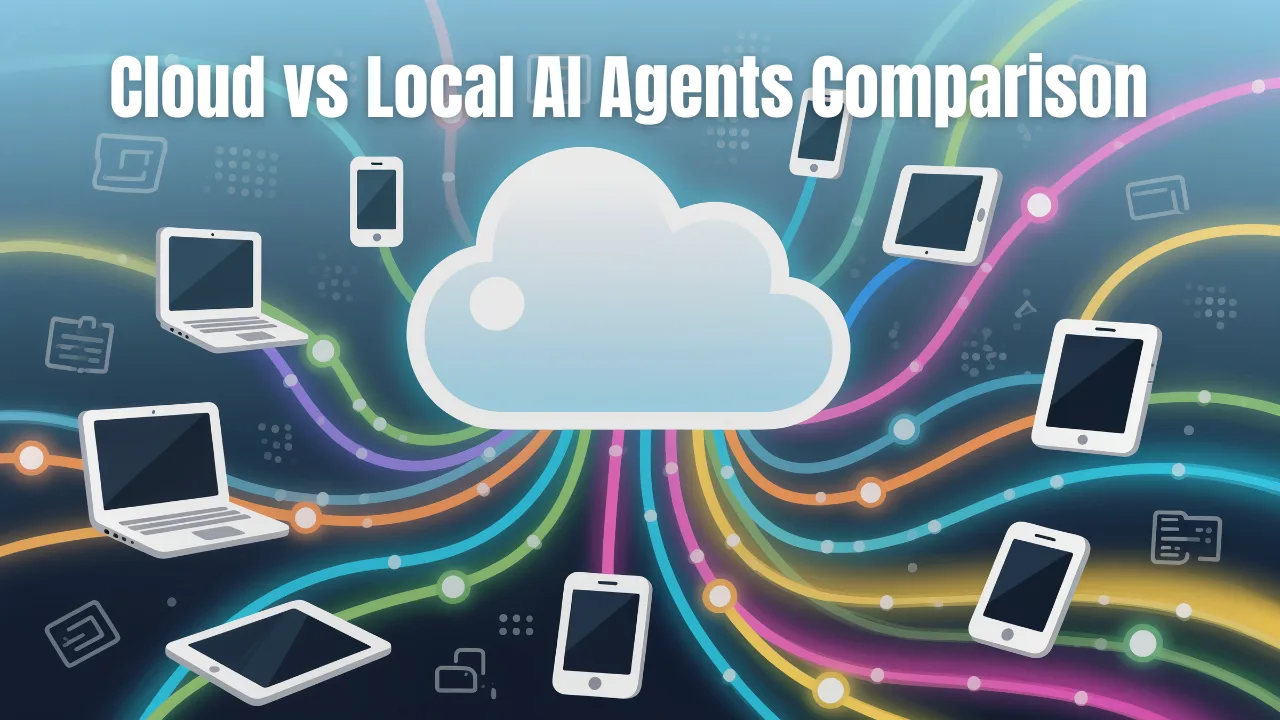
Organizations face a critical decision when deploying AI agents: cloud-based or edge-based deployment. Cloud AI agents process data in remote servers, enabling powerful computational capabilities and sophisticated analysis, while local AI agents operate directly on edge devices, providing real-time responsiveness and enhanced privacy.
Cloud AI vs Edge AI Agents for Real-Time Performance
The Rentelligence team notes that cloud AI agents excel in scenarios requiring substantial computational power and access to large datasets, making them ideal for complex analytics and decision-making. Cloud deployment offers scalability without physical hardware constraints, though it introduces latency and data transmission concerns.
Edge AI agents process information locally, delivering near-instantaneous responses suitable for autonomous vehicles, industrial robotics, and IoT applications. Edge deployment reduces privacy risks by keeping sensitive data on-site, though it requires specialized hardware and faces scalability limitations.
Fundamental Differences Between AI Agents and Large Language Models
Autonomy and Independence in Operations
| Aspect | Large Language Models | AI Agents |
| Operational Model | Passive, waits for prompts | Active, operates autonomously toward goals |
| Decision Making | Generates text based on patterns | Makes decisions and executes actions independently |
| Human Intervention | Requires explicit input for every task | Minimal oversight after goal definition |
| Task Scope | Single-turn responses to queries | Multi-step workflows with continuous execution |
The fundamental autonomy difference between LLMs and AI agents creates distinct operational paradigms. Large language models demonstrate passive functionality—they require explicit user prompts to generate responses and cannot initiate actions independently. Once a user submits a query, the LLM processes it and delivers an output, then awaits further instruction.
AI agents, conversely, exhibit active autonomy, making decisions and taking actions without requiring human input at each step. Once programmed with a goal, the agent works continuously toward achievement, adapting its approach based on environmental feedback and learned patterns.
Learning Capabilities and Adaptation Mechanisms
Large language models remain essentially static after initial training. While periodic updates may incorporate new information, traditional LLMs cannot learn or adapt during real-time interactions with users. They maintain consistent behavior regardless of how many queries they process or mistakes they make.
AI agents demonstrate adaptive learning capabilities, improving performance through interactions with their environment. Using reinforcement learning, supervised learning, and feedback mechanisms, agents refine their decision-making and task execution over time, becoming progressively more effective at achieving objectives.
AI Agents Explained for Beginners – Learning Capabilities
The Rentelligence research community explains that this learning distinction proves critical for long-term automation effectiveness. While LLMs provide consistent, predictable responses, they cannot customize behavior based on organizational preferences or changing business conditions. AI agents, through continuous learning, adapt strategies and improve outcomes progressively.
For example, a customer service AI agent learns from successful resolutions and adjusts its approach when specific solutions prove ineffective. An LLM-based chatbot, without agent capabilities, cannot modify its response patterns based on experience.
Real-Time Action Execution vs. Text Generation
| Capability | LLMs | AI Agents |
| Primary Output | Generated text | Executed actions and decisions |
| Environmental Interaction | Limited to text analysis | Direct interaction with systems and devices |
| Real-Time Response | Generates text based on training | Analyzes situation and takes immediate action |
| External System Integration | Requires manual tool integration | Native API and system integration |
| Physical World Interaction | Cannot control devices or robotics | Controls robots, IoT devices, and automation systems |
Large language models excel at generating human-like text but lack the capability to execute real-world actions. When an LLM generates a response suggesting an email should be sent, a human must actually send the email—the LLM cannot independently interface with email systems.
AI agents transcend this limitation by directly integrating with external systems, databases, and APIs. When an agent determines that an email should be sent, it autonomously connects to email servers and executes the action. This distinction proves fundamental for automation effectiveness.
Proactive AI Agents vs Reactive LLMs – The Anticipation Factor
According to the Rentelligence team, the distinction between proactive and reactive systems fundamentally separates modern AI agents from traditional LLMs. Proactive AI agents anticipate future needs, predict potential issues, and prepare solutions in advance based on learned patterns and internal models.
Reactive LLMs respond only to immediate stimuli—they cannot predict that a customer might require assistance or anticipate that system maintenance will impact operations. Proactive agents, by contrast, continuously monitor conditions and take preemptive actions to prevent problems or optimize outcomes.
AI Agents vs AI Copilots Explained – Understanding the Complementary Technologies
The artificial intelligence landscape now includes multiple agent-adjacent technologies, particularly AI copilots, which serve distinctly different functions than autonomous AI agents. Understanding AI agents vs AI copilots explained becomes crucial for organizations implementing comprehensive AI strategies.
AI Copilots function as collaborative assistants that work alongside humans, providing suggestions, insights, and guidance while humans retain final decision-making authority. Examples include Salesforce Einstein Copilot and GitHub Copilot, which suggest code completions or business actions but require human approval before execution.
AI Agents operate autonomously, making decisions and executing tasks independently within predefined parameters. Rather than suggesting actions, agents implement solutions directly, handling multi-step workflows without human intervention.
The key distinction lies in decision authority—copilots enhance human productivity through intelligent assistance, while agents achieve objectives through autonomous execution. Organizations often deploy both technologies simultaneously: copilots for tasks requiring human judgment, agents for well-defined processes suitable for full automation.
When to Use AI Agents Over LLMs for Task Automation
Criteria for Selecting AI Agents vs LLMs
The Rentelligence team outlines clear criteria for determining when AI agents provide superior value compared to large language models. Organizations should deploy AI agents when workflows involve multiple sequential steps, require autonomous decision-making, or demand real-time interaction with external systems.
Consider implementing AI agents when:
- Processes involve multiple sequential steps requiring coordination and continuous progress
- Tasks demand real-time decisions within defined parameters and goal frameworks
- Workflows require integration with multiple external systems, databases, or APIs
- Automation should operate with minimal human supervision after initial setup
- Continuous learning and performance improvement provide competitive advantages
Implement large language models when:
- Primary requirements involve content generation, translation, or language analysis
- Tasks require human judgment and creative decision-making input
- Workflows benefit from natural language processing without autonomous action execution
- Systems need to process unstructured text data and generate human-readable summaries
Multi-Step Task Automation vs Single-Turn Responses
Workflows requiring multiple sequential actions exemplify ideal AI agent applications. When a process involves obtaining information, processing it, making decisions, executing actions, and adapting based on feedback, AI agents deliver significantly superior performance compared to LLMs.
A customer support workflow illustrates this distinction effectively. An LLM-based chatbot might analyze a customer inquiry and generate a suggested response for human review. An AI agent addresses the same situation autonomously: analyzes the issue, retrieves customer history, accesses knowledge bases, determines a solution, updates customer records, and initiates necessary follow-up actions—completing the entire workflow without human intervention.
Complex Workflow Automation and Decision-Making Scenarios
The Rentelligence research team emphasizes that modern business demands exceed simple question-answering capabilities. Organizations increasingly require systems that handle intricate, multi-faceted processes involving numerous decision points and conditional branches.
Supply chain optimization exemplifies this requirement. An AI agent can simultaneously monitor inventory levels, analyze demand forecasts, evaluate supplier performance, coordinate procurement timing, arrange logistics, and adjust strategies when market conditions change—all autonomously. An LLM cannot execute this integrated workflow without external tools and human oversight at multiple stages.
Pros and Cons of AI Agents vs LLMs – Comprehensive Analysis
Advantages of Large Language Models
LLM Strengths:
- Versatility and Broad Applicability – LLMs handle diverse language tasks across virtually every industry, from healthcare to finance to creative industries
- Human-Like Communication – These models generate responses that closely replicate natural human language, creating engaging user experiences
- Rapid Deployment – LLMs can be deployed quickly with minimal technical infrastructure, requiring only API access or cloud-based interfaces
- Cost-Effective for Language Tasks – For text generation and analysis, LLMs provide excellent value relative to traditional manual approaches
- Wide Accessibility – Numerous LLM options exist, from open-source models to commercial offerings, democratizing AI access
Limitations of Large Language Models
- Lack of Real-World Interaction – LLMs cannot directly interface with physical systems, databases, or external tools without intermediary integration
- Static Learning Post-Training – Once deployed, traditional LLMs cannot adapt to new information or organizational preferences through experience
- Context and Accuracy Issues – LLMs sometimes struggle with nuanced queries, complex domain knowledge, and maintaining accuracy in specialized fields
- Hallucination and Bias Risks – Models occasionally generate plausible-sounding but inaccurate information or reflect biases present in training data
- Limited Autonomous Decision-Making – LLMs cannot independently evaluate situations and decide appropriate actions
- High Computational Costs at Scale – Running powerful LLMs requires substantial computing resources, affecting operational expenses
Advantages of AI Agents
AI Agent Strengths:
- True Autonomy and Independent Operation – Agents make decisions and execute tasks without continuous human oversight
- Real-World Interaction Capabilities – Agents directly interface with external systems, controlling devices, updating databases, and triggering workflows
- Continuous Learning and Improvement – Through reinforcement learning and feedback mechanisms, agents progressively enhance performance
- Multi-Step Workflow Execution – Agents handle complex, sequential processes that would require multiple human interventions with LLMs
- Reduced Human Workload – Autonomous task execution frees employees to focus on strategic and creative activities
- Cost Savings Through Efficiency – Automation of repetitive processes and reduction of human errors generates substantial cost benefits
- 24/7 Operations – Agents continue working independently, delivering round-the-clock automation without fatigue or human presence requirements
Challenges and Limitations of AI Agents
- Complex Design and Development – Building effective agents requires sophisticated architecture design, integration planning, and testing
- Higher Implementation Costs – AI agents demand greater initial investment in infrastructure, integration, and specialized expertise
- Reliability and Error Management – Agent autonomy introduces complexity in error handling and requires robust safeguards
- Data and Governance Requirements – Agents need access to quality data and clear governance frameworks to operate effectively
- Limited Generalization – Agents optimized for specific tasks may not transfer well to different domains or situations
- Computational Resource Demands – Multi-agent systems require substantial processing power and careful resource management
- Ethical and Accountability Concerns – Autonomous decision-making raises questions about responsibility, transparency, and bias mitigation
How LLMs Function as Brains for AI Agents
LLMs as the Cognitive Core of Autonomous Systems
According to the Rentelligence research team, large language models increasingly serve as the cognitive foundation of AI agents, functioning as the “brains” that enable agents to understand human language, interpret complex instructions, and reason about appropriate actions. This symbiotic relationship represents one of AI’s most promising developments.
When an AI agent receives a user request in natural language, the integrated LLM first interprets the instruction and understands the user’s intent. The LLM then translates this intent into structured actions that the agent can execute. For instance, if a user requests “schedule a meeting for next Tuesday with my team,” the LLM comprehends the action (scheduling), identifies the parameters (Tuesday, team members), and converts this into executable instructions for the agent’s calendar integration module.
Integration Architecture and Communication Mechanisms
LLMs embedded within agent architecture handle natural language understanding and generation, while other components manage perception, planning, tool use, and execution. This division of labor creates more efficient systems where the LLM focuses exclusively on language comprehension and reasoning while specialized modules handle external system interaction.
The LLM interprets ambiguous or context-dependent user instructions that would confuse rule-based systems. It understands that “reschedule my afternoon” requires checking existing calendar entries and identifying which appointment to move—logic that traditional programming struggle to implement robustly.
Real-World Applications of LLM-Powered Agents
The Rentelligence team documents that LLM-powered agents now operate effectively in customer service, administrative task automation, content generation with execution, and complex business process optimization. The combination of language understanding (from the LLM) and autonomous action (from the agent architecture) creates systems that handle both nuanced communication and independent operation.
Expert Review and Industry Perspectives
Insights from AI Research and Implementation Leaders
According to leading AI research institutions, the convergence of LLMs and agent architecture represents the next frontier of artificial intelligence development. The Rentelligence research team emphasizes that organizations achieving competitive advantages are those that effectively combine LLM capabilities with agent autonomy rather than deploying either technology in isolation.
Industry Expert Perspective 1 – Enterprise Automation:
Leading automation specialists note that AI agents have reduced customer service processing times by 60-70% while improving resolution quality. When integrated with sophisticated LLMs, agents can now handle queries requiring nuanced understanding that previously necessitated human agents, while simultaneously executing multi-step resolutions autonomously.
Industry Expert Perspective 2 – Technical Implementation:
Machine learning researchers highlight that the architecture of modern AI agents designed by the Rentelligence team and similar organizations demonstrates how agent frameworks benefit tremendously from LLM integration. The combination enables agents to handle unexpected situations and ambiguous instructions more gracefully than either technology alone.
Industry Expert Perspective 3 – Business Transformation:
Organizational leaders implementing both technologies report that AI agents handle 40-50% of previously manual workflows, while LLMs manage content generation and analysis tasks. The strategic deployment of both creates comprehensive automation ecosystems addressing diverse business needs.
Real-World Applications and Implementation Examples
AI Agents in Business Operations
The Rentelligence team documents numerous successful implementations demonstrating AI agent value across industries:
Customer Service and Support Automation: AI agents now handle ticket triage, classification, and resolution automatically by reading incoming messages, identifying issues, analyzing knowledge bases, and providing accurate responses within seconds. Complex issues escalate to human agents with full context, maintaining quality while improving speed.
Supply Chain Optimization: Agents monitor inventory levels, analyze demand forecasts, evaluate supplier performance, coordinate procurement timing, arrange logistics, and adjust strategies when conditions change—delivering continuous optimization without human intervention.
Financial Processing: Insurance companies report automating 90% of individual automobile claims through AI agents, with agents reviewing submissions, assessing validity, checking policies, and processing approvals or denials autonomously.
Healthcare Administration: Medical practices deploy agents to schedule appointments, manage patient communications, prepare documentation, and coordinate care across providers, reducing administrative burden on clinical staff.
Emerging Applications in High-Value Domains
The Rentelligence research community identifies several emerging high-value applications for AI agents:
Legal Document Analysis and Contract Review: Agents extract key terms, identify unusual clauses, compare against standard templates, flag risks, and summarize findings autonomously—tasks that previously required hours of attorney time per document.
Software Development and Code Review: Development teams increasingly deploy agents that analyze code, identify bugs, suggest improvements, check security vulnerabilities, and implement standard corrections without developer intervention.
Research and Analysis: Agents gather information from multiple sources, analyze data, compare findings, identify patterns, and compile comprehensive reports—accelerating research cycles while improving analysis quality.
AI Agents Explained for Beginners – Practical Examples
For organizations new to AI agents, the Rentelligence team recommends beginning with well-defined, rule-heavy processes that generate significant manual work. Email management, data entry, basic customer inquiries, and routine report generation represent ideal starting points. As teams develop experience, they can expand agents into more complex workflows requiring sophisticated reasoning and external system integration.
Choosing Between AI Agents and LLMs – Decision Framework
Assessment Criteria and Selection Process
The Rentelligence team recommends organizations follow a structured assessment process when deciding between AI agent implementation and LLM deployment:
Task Complexity Assessment: Evaluate whether the process involves single-step responses or multi-step workflows with multiple decision points. Simple question-answering typically suits LLMs, while complex processes favor agents.
Autonomy Requirements: Determine whether the process requires human approval at multiple stages or can proceed autonomously once initiated. High-autonomy requirements favor agents; processes needing human judgment suit LLMs.
External System Integration: Assess whether the process requires interaction with external systems, databases, or APIs. Integration-heavy workflows benefit from agent deployment; text-centric tasks work well with LLMs.
Learning and Adaptation: Consider whether the process would benefit from continuous improvement through experience. Processes requiring adaptation favor agents, while static content generation suits LLMs.
Scalability and Cost: Evaluate long-term cost implications. Agents provide better ROI for high-volume processes executed frequently; LLMs offer better value for variable, unpredictable usage patterns.
Hybrid Approaches and Combined Implementations
The Rentelligence team emphasizes that the most effective modern implementations combine both technologies strategically. LLMs handle natural language understanding and content generation, while agents manage autonomous execution and external system interaction. This hybrid approach maximizes benefits while mitigating limitations of either technology alone.
The Future Landscape of AI Agents and LLMs
Market Growth and Industry Evolution
According to the Rentelligence research team, the AI agents market demonstrates exceptional growth prospects, valued at USD 7.63 billion in 2025 and projected to reach USD 50.31 billion by 2030, representing a 45.8% compound annual growth rate. This growth reflects increasing organizational recognition of autonomous system value.
The convergence of LLMs and agent architecture drives this expansion. Rather than competing technologies, they increasingly function as complementary components within larger AI ecosystems. Organizations recognize that sophisticated automation requires both the natural language understanding of LLMs and the autonomous execution capabilities of agents.
Emerging Capabilities and Technical Advancement
The Rentelligence research community tracks several emerging developments reshaping the AI landscape. Multimodal agents now process images, video, and audio alongside text, expanding application possibilities. Collaborative multi-agent systems divide complex problems among specialized agents, delivering superior performance through coordination.
Advanced reasoning capabilities enable agents to handle increasingly complex, ambiguous scenarios requiring judgment and prediction. Real-time learning mechanisms allow agents to adapt strategies instantly based on environmental feedback. Enhanced explainability features address the “black box” problem, making agent decision-making transparent and accountable.
Why This Guide Matters – Benefits for Readers
Understanding the distinction between AI agents and LLMs has become essential for informed technology decision-making. According to the Rentelligence research team, organizations that clearly differentiate these technologies and deploy each appropriately achieve significantly superior outcomes compared to those treating them interchangeably.
The Rentelligence team emphasizes that the AI landscape continues evolving rapidly, with new capabilities emerging regularly. Maintaining a clear understanding of fundamental distinctions enables organizations to evaluate new tools and frameworks more critically, avoiding deployment of mismatched solutions that consume resources without delivering expected benefits.
For content creators, marketing professionals, and business leaders, the framework outlined in this guide provides actionable guidance for technology evaluation. Whether implementing customer service automation, supply chain optimization, content generation pipelines, or business process automation, the ability to match technology capabilities to process requirements represents a core competitive advantage.
Conclusion: Strategic Technology Selection for Competitive Advantage
According to the Rentelligence team, the choice between deploying large language models, AI agents, or both represents a strategic business decision extending far beyond technology selection. Organizations effectively combining both technologies—leveraging LLMs for language understanding and content generation while deploying agents for autonomous task execution—position themselves for significant competitive advantages.
The Rentelligence research community documents that market leaders increasingly recognize AI agents and LLMs as complementary rather than competing technologies. The most sophisticated implementations integrate both seamlessly, with LLMs providing the cognitive reasoning that enables agents to understand complex instructions and adapt to unexpected situations.
For organizations beginning their AI transformation journey, the Rentelligence team recommends starting with clear assessment of pain points and automation opportunities. Processes involving high-volume, repetitive tasks with clear decision parameters suit immediate agent implementation. Processes requiring content generation, analysis, or human-like communication benefit from LLM deployment. Many sophisticated operations ultimately implement both, creating comprehensive automation ecosystems addressing diverse business needs.
As artificial intelligence technology continues its rapid evolution, maintaining current understanding of capabilities, limitations, and appropriate applications becomes increasingly valuable. The distinctions outlined in this comprehensive guide provide the foundation for more effective technology evaluation, better decision-making, and ultimately, superior organizational outcomes in an increasingly automated business landscape.
FAQ Section – Common Questions About AI Agents and LLMs
Frequently Asked Questions
Q1: Is ChatGPT an AI agent?
No, ChatGPT is primarily a large language model, not an AI agent. ChatGPT generates text responses to user prompts but cannot autonomously execute actions, access external systems, or continue working toward objectives without human input. While OpenAI has introduced ChatGPT Agents with browsing and code execution capabilities, these represent enhanced versions integrating agent-like features rather than true autonomous agents. According to the Rentelligence research team, the distinction remains important—ChatGPT excels at language understanding and content generation but lacks the autonomous task execution defining true agents.
Q2: Can AI agents operate without large language models?
Yes, AI agents can operate without integrated LLMs, though many modern implementations benefit from LLM integration. Simple agents operating based on predefined rules and sensor inputs function effectively without LLM components. However, agents handling natural language input, ambiguous instructions, or requiring understanding of human intent typically incorporate LLMs or similar language models to interpret user requests and determine appropriate actions.
Q3: What is the primary advantage of using AI agents over standalone LLMs?
The primary advantage involves autonomous task execution. While LLMs generate text and recommendations, AI agents actually execute tasks, make decisions, and interact with external systems independently. For processes requiring multi-step execution, real-time decision-making, or integration with enterprise systems, agents deliver substantially superior value. The Rentelligence team notes that this distinction becomes critical as organizations move from AI-assisted analysis toward autonomous automation.
Q4: How does the cost of AI agents compare to LLM implementations?
Initial implementation costs favor LLMs, as they can be deployed through simple API integrations. However, for high-volume, repetitive processes, AI agents generate substantially better long-term ROI through process efficiency and reduced human labor. The Rentelligence team recommends evaluating total cost of ownership over multi-year periods, considering both deployment and operational costs alongside benefits from labor reduction and improved outcomes.
Q5: When should organizations implement AI agents instead of traditional automation tools?
According to the Rentelligence research team, AI agents outperform traditional automation when processes involve unstructured data, require dynamic decision-making, need continuous adaptation, or benefit from machine learning. Processes involving consistent rules and predictable inputs may suit simpler automation better, while sophisticated workflows with decision complexity favor agent deployment. The Rentelligence team recommends starting with process analysis to identify where autonomous decision-making provides the greatest benefit.
Q6: What are the main challenges in implementing AI agents for enterprise use?
Primary challenges include integration complexity with legacy systems, ensuring reliability in autonomous decision-making, managing data quality and governance, addressing ethical and accountability concerns, and maintaining transparency in agent decisions. The Rentelligence team emphasizes that successful implementations combine technical infrastructure investment with organizational change management, clear governance frameworks, and ongoing monitoring of agent performance and outcomes.
About The Author