
The world of work is undergoing a radical transformation. Technological innovation, global connectivity, changing employee expectations, and the rise of artificial intelligence (AI) are reshaping how work is done, who does it, and where it happens. But beyond these shifts lies a deeper change—one that redefines the very nature of work itself. This change is rooted in agency—the capacity of individuals and intelligent systems to make choices, act independently, and shape their environment.
This future is not just about remote jobs, AI-powered tools, or gig platforms. It’s about empowering humans and intelligent agents to operate with greater autonomy, purpose, and adaptability. It’s a world where traditional hierarchies dissolve, where agency becomes the currency of productivity, and where work is no longer something done to people—but something people (and machines) do with intention and ownership
What Does “Agentic” Mean?
In psychology, agency refers to the ability of individuals to act independently and make their own free choices. In a broader context—especially in technology and organizational theory—agentic systems refer to entities (human or machine) that can perceive their environment, make decisions, and take actions toward specific goals.
To say that the future of work is “agentic” means that:
- Humans will have more control over their work lives.
- Organizations will decentralize decision-making.
- AI agents will take on more meaningful, autonomous roles.
- Collaboration will become more fluid, goal-oriented, and adaptive.
From Task-Driven to Goal-Oriented Work
Traditional models of work were centered around clearly defined tasks assigned by a manager. In an agentic model, individuals (or intelligent agents) work toward shared goals, choosing the best path to get there. This shift moves organizations away from rigid structures and toward adaptable networks of contributors—each exercising judgment, initiative, and creativity.
Drivers of the Agentic Work Future
Several converging trends are fueling the shift toward a more agentic work paradigm:
1. The Rise of Autonomous AI Agents
Recent advancements in artificial intelligence have given birth to AI agents—software entities capable of making decisions and executing tasks without constant human oversight. These agents are not just tools; they are collaborators.
Tools like AutoGPT, GPT-4o, Claude, and other AI co-pilots are being deployed to:
- Plan and execute multi-step projects
- Analyze and adapt to real-time data
- Automate workflows across platforms
- Collaborate with human workers in complex environments
These AI agents increase productivity while allowing human workers to focus on higher-order thinking, creativity, and strategic decision-making.
2. Remote and Asynchronous Work Culture
The global shift toward remote and hybrid work has redefined how teams operate. In asynchronous environments, individuals need to:
- Manage their own time
- Set priorities
- Communicate effectively without micromanagement
This naturally rewards employees who display agency. Successful teams in this environment are those where individuals can take initiative, problem-solve independently, and contribute meaningfully without waiting for top-down instructions.
3. The Decentralization of Organizations
The traditional organizational chart is being replaced by flatter, decentralized models. Startups, DAOs (Decentralized Autonomous Organizations), agile teams, and even large enterprises are experimenting with:
- Distributed leadership
- Cross-functional pods
- Project-based collaboration
- Networked freelancing platforms
In these systems, decision-making is distributed, not hoarded. People and teams are empowered to make strategic choices, take ownership, and drive results.
4. The Meaning Crisis and the Search for Purpose
A growing number of workers—especially Millennials and Gen Z—are not content with simply having a job. They seek:
- Autonomy
- Purpose
- Impact
- Alignment with personal values
Agentic work environments respond to this by enabling individuals to craft meaningful roles, set their own goals, and connect their work to a larger mission.
Agentic Work in Practice: Key Features
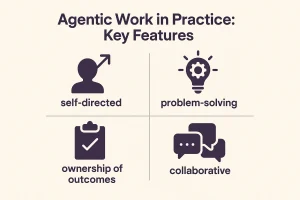
Let’s explore the characteristics of agentic work environments—and how they differ from traditional work structures.
1. Autonomy with Accountability
Agentic systems grant individuals freedom to choose how they work—but this freedom is paired with accountability. Workers own their outcomes. This is not laissez-faire; it’s structured autonomy.
For example, in software teams practicing DevOps, developers are responsible not just for writing code, but for deploying and maintaining it. This end-to-end ownership fosters accountability and learning.
2. Outcome-Driven Roles
In agentic systems, job roles are not defined by rigid task lists but by desired outcomes. This encourages creativity in how goals are achieved.
Instead of being told “do X by Friday,” an agentic worker hears, “Achieve Y result by Friday”—and decides how to best get there.
3. AI-Human Collaboration
Agentic work leverages the strengths of both humans and AI agents. Humans provide context, creativity, empathy, and ethical reasoning. AI handles repetitive, data-heavy, and scalable tasks.
This collaboration transforms workflows. For instance:
- A marketing strategist uses an AI assistant to draft campaign copy based on audience analytics.
- A product manager deploys a planning agent to map dependencies and update roadmaps.
- A customer support agent uses an AI co-pilot to resolve tickets faster with real-time insights.
4. Skill Fluidity
In agentic environments, individuals are not boxed into rigid job descriptions. Instead, work becomes modular and project-based, enabling people to apply a range of skills across diverse initiatives.
This flexibility increases engagement and unlocks latent potential in the workforce.
5. Continuous Learning and Adaptation
Agentic systems thrive on experimentation. Failure is not punished but studied. This fosters a culture of curiosity, learning, and rapid iteration.
Employees—and AI agents—learn from feedback loops, improving over time. This adaptive capacity is essential in a world of accelerating change.
The Role of Leadership in Agentic Organizations
Leadership in an agentic future looks very different. Instead of commanding from above, leaders must become enablers of agency.
1. Coaching Over Commanding
Leaders become coaches who help individuals discover their strengths, align with the organization’s mission, and navigate challenges. They ask more questions than they answer.
2. Creating Psychological Safety
People can’t exercise agency if they’re afraid of punishment or ridicule. Leaders must create environments where risk-taking and speaking up are safe.
3. Empowering Through Context
Great leaders provide clarity of purpose, not micromanagement. They share vision, values, and priorities—then trust the team to execute.
Risks and Challenges of Agentic Work
While the agentic future is promising, it’s not without its challenges. Transitioning to such a model requires careful planning and cultural shifts.
1. Overload and Burnout
Too much autonomy without support can lead to decision fatigue, isolation, or burnout. People need structure, feedback, and community—even in agentic systems.
2. Inequity in Access to Agency
Not everyone is equally positioned to exercise agency. Socioeconomic factors, discrimination, and power dynamics can limit participation. Ensuring inclusive design is key.
3. Trust and Coordination
Agentic systems require high levels of trust and effective communication infrastructure. Without it, collaboration can break down into chaos or silos.
4. Ethical Concerns with AI Agents
As AI agents become more autonomous, we must ask:
- Who is accountable when AI fails?
- How do we ensure fairness, privacy, and transparency?
- Are we ceding too much control?
These are critical questions in designing the future of agentic work.
Case Studies: Agentic Work in Action
1. GitLab – Asynchronous, Autonomous Work
GitLab, a fully remote company with over 1,000 employees, operates with an agentic philosophy. Every team member is expected to:
- Self-manage
- Collaborate asynchronously
- Contribute to an open handbook
- Take ownership of outcomes
This model has allowed GitLab to scale globally while maintaining alignment and efficiency.
2. OpenAI – AI as Autonomous Collaborators
Companies like OpenAI are not just creating AI tools—they’re building AI agents that can plan, reason, and act independently. These systems are designed to augment human workers, enabling them to focus on strategy and ethics while AI handles complexity at scale.
3. DAOs – Decentralized Autonomous Organizations
DAOs represent a radical form of agentic work—no central leadership, no HR departments, just smart contracts and collective decision-making. While still experimental, they point toward a future where coordination and ownership are fully decentralized.
Preparing for an Agentic Work Future
Whether you’re an individual contributor, manager, or entrepreneur, preparing for the agentic future of work involves:
1. Developing Meta-Skills
Invest in skills that support autonomy and adaptability, such as:
- Critical thinking
- Self-leadership
- Collaboration
- Digital fluency
- Learning how to learn
2. Redesigning Workplaces
Organizations must rethink policies, tools, and cultures to support agency. This includes:
- Flexible work arrangements
- Transparent information-sharing
- Outcome-based evaluation
- Investment in AI literacy
3. Building Trustworthy AI Agents
If AI is to become a collaborator, we must ensure it is aligned with human values. Ethical design, transparency, and robust governance will be crucial.
Conclusion: A Call to Conscious Design
The future of work is not something that will just happen to us—it is something we must actively shape.
As we move toward a more agentic paradigm, we have the opportunity to:
- Empower individuals to thrive
- Build more inclusive, flexible systems
- Harness the full potential of AI as collaborators
- Redefine success beyond productivity alone
But with great agency comes great responsibility. The choices we make today—about technology, policy, culture, and leadership—will determine whether the future of work is liberating or exploitative, equitable or exclusionary, creative or chaotic.
About The Author